
Why One-Page Websites are a Bad Idea for Business Websites
As a business owner, you may have come across one-page websites as an option for your business. These sites have become increasingly popular in recent years because they’re fast and cheap to build.
On the surface, one page websites seem convenient — easy to scroll through on mobile devices and offering a simple user experience. But beneath this apparent simplicity lies a host of issues that make them a poor choice for most businesses.
What are one-page websites?
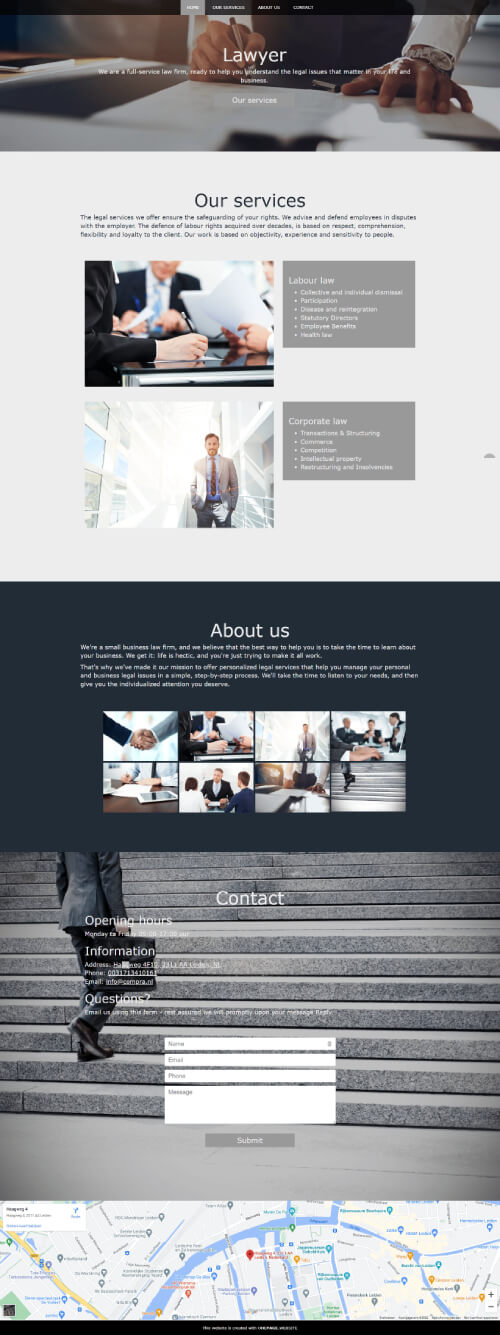
One-page websites mimic the structure of traditional multi-page sites, with navigation links at the top of the page. However, instead of taking users to different pages, these links direct them to sections further down the same page. While this design might seem efficient, it comes with significant drawbacks especially when it comes to search engine optimisation (SEO) and scalability.
Reasons why one-page websites are hard for Google to find and recommend
Getting found on Google is one of the most important things your website needs to do — and this is where one-page websites fall down badly.
Think of Google like a librarian. When someone searches for something, Google scans millions of websites and tries to match the best, most relevant page to that search. To do this well, it needs each page to be clearly about one specific topic. Here's how Google itself explains it.
A one-page website tries to cover everything — your services, your story, your contact details — all in one place. That's like handing the librarian a book that's simultaneously a cookbook, a travel guide, and a legal dictionary. It's confusing, so Google struggles to know when to recommend you.
Lack of fresh content
One-page websites also fall short when it comes to adding fresh content. Without a dedicated blog section, you lose the opportunity to publish regular updates, news, or insights. Blogs are one of the best strategies for adding value, driving website traffic, ranking for new keywords and keeping your website regularly indexed by search engines.
Poor user insights
Another downside is the inability to track user behaviour effectively. With a single page, tools like Google Analytics can’t provide detailed insights into which sections of your site visitors engage with the most. This lack of data makes it harder to refine your marketing strategy or improve user experience.
Slow load times
Despite their simplicity, one-page websites can suffer from slow load times due to the volume of content crammed onto a single page. Large images and lengthy sections contribute to slower speeds, which not only frustrates users but also negatively impacts your SEO.
Limited scalability
One-page websites are not built for growth. If you want to add more products, services, or information, you’ll quickly run out of space. Expanding a one-page site means making it excessively long, which diminishes user experience and forces you to remove valuable content.
Why one-page websites get ignored by AI search tools like ChatGPT
Search behaviour is changing fast. By January 2026, 45% of consumers were using AI tools like ChatGPT, Google's AI Overviews, and Perplexity to find local businesses — up from just 6% a year earlier. That's a massive shift in how your next customer might find you.
- 45% of consumers used AI to find local businesses by Jan 2026
- 6% did the same just 12 months earlier
- 44% of Google searches now show AI Overviews at the top
The problem for one-page websites? AI search tools prioritise content that is clearly structured, specifically focused, and supported by schema markup. A one-page site — with a single URL, a single title tag, and content covering everything from your services to your contact details — gives AI systems very little to work with. There's no dedicated service page to cite, no blog post to reference, no FAQ structure to surface in a People Also Ask result.
Multi-page websites, by contrast, can use structured data (like FAQ schema, Service schema, and LocalBusiness schema) across individual pages to signal exactly what each page is about. That's what gets your business cited — and chosen — in AI-generated answers.
In short, a one-page website doesn't just hurt your Google rankings. In 2026, it may make you invisible to an entirely new generation of search.
How many pages does a business website actually need?
To build a website that works for your business, we recommend starting with a minimum of five pages:
- Home Page – A welcoming introduction to your business.
- About Page – Share your story and build trust with visitors.
- Services Page – Detail what you offer.
- Contact Page – Make it easy for customers to get in touch.
- Privacy Policy Page – A must-have for compliance and transparency.
From there, we recommend adding individual pages for each product or service, and a blog section for ongoing updates.
We also recommend integrating the site with a CRM so that enquirers are followed up quickl and professionally, and you have a database of prospects to convert into customers.
What to build instead — and why it makes a real difference
A bespoke, beautifully designed, well-structured, multi-page website is a highly valuable asset that engages prospects, and generates quality leads and sales.
If you’d like a site that achieves these goals, let’s talk. We’ll create you a tailored website that works hard for your business, just as we have for many Australian business owners.
